
Industries29 Sept 2026 · 8 min read
Warranty and service labels for car workshops
Oil, degreaser, engine bay heat and gloved hands. Which stock and adhesive keep a label legible after a year in the workshop.
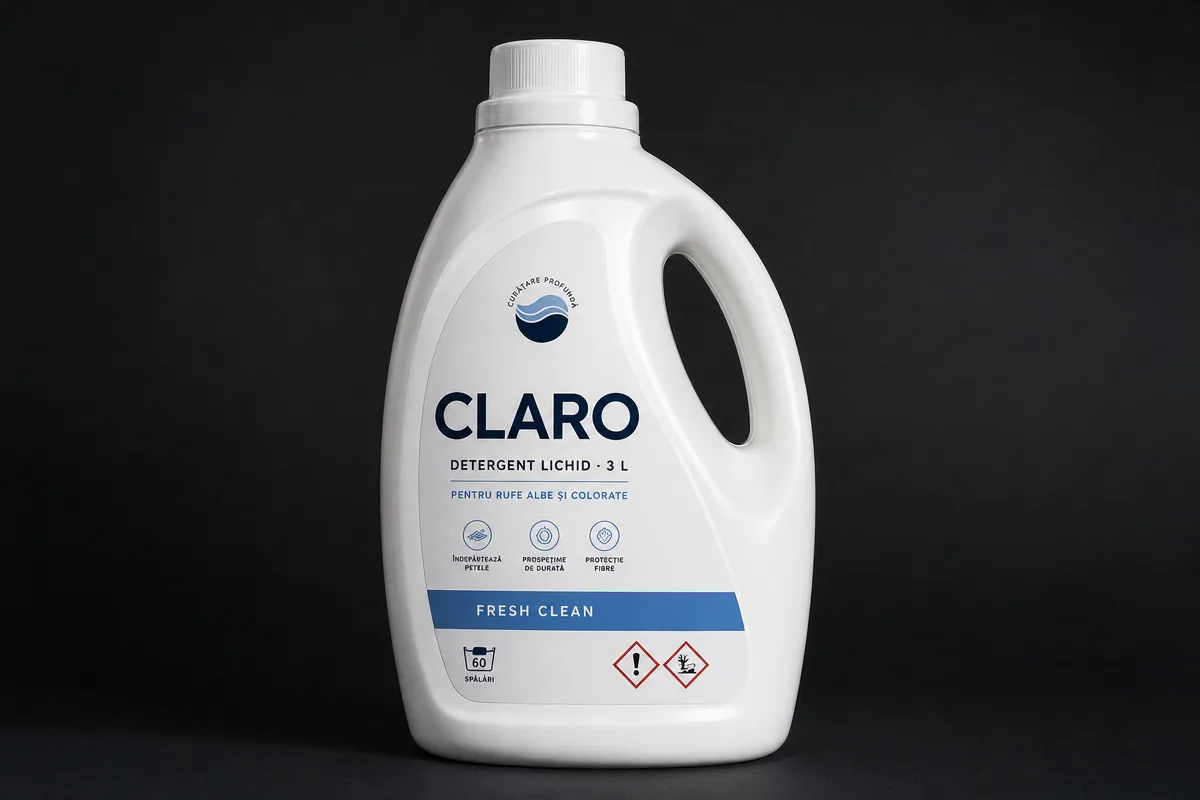
In a workshop the label is not decorative. It states what was fitted, when, by whom and how long the work is covered. The problem is that the workshop environment destroys exactly the cheap materials everyone uses: uncoated paper, weak adhesive, print that wipes off with an oily finger.
Which stock survives a workshop
The default choice is white PP film with a high-tack permanent adhesive and matte lamination. It absorbs no fluids, doesn't tear in handling and takes ballpoint writing over matte lamination. Polyester only enters the discussion near a heat source or with frequent solvent wiping, and it is not a stock we print.
- Shelf boxes in a dry area: matte laminated self-adhesive paper.
- Greasy parts in direct contact: white PP, permanent adhesive, matte lamination.
- Engine bay or hot zones: polyester, a stock we do not print; we supply laminated white PP for the rest of the workshop.
- Small curved surfaces such as sensors: thin film, round or oval die-cut.
- Fluid containers: film, since the label touches the product.
Warranty labels and void labels are not the same
A warranty label documents the work and stays intact. A void label is a seal that destroys itself on removal and leaves a visible pattern on the surface. The first is read, the second is checked. Many workshops ask for one and get the other, because the brief only says warranty.
If the goal is to see whether someone opened a component, you need void material, and the application surface must be tested: on some low surface energy plastics the residual pattern does not stay as expected.
What goes on an intervention label
The useful minimum is date, mileage, work performed and who did it. On top of that, anything that helps identification two years later, when the car reaches a different workshop: internal job code, part fitted, and for software work the version and write date.
This matters most for work you cannot see. A workshop that runs a full diagnostic before any intervention, such as a car service in Brasov, needs a written trace of the prior condition, not only of the work performed.
The same logic applies to engine control unit work, where nothing visible remains under the bonnet. Workshops doing ECU and TCU chiptuning usually apply a label with the file version and write date, because otherwise the information disappears entirely.
Shelf and part identification labels
In a small workshop the biggest time loss comes from searching, not from the work itself. A removed part waiting for estimate approval, with no identification, can block a car on the lift for a whole day. A simple label with the job number solves it.
- Job number, printed large, readable from two metres.
- Removal date, for parts awaiting a decision.
- Optional QR code opening the digital job record.
- Removable adhesive on parts that go back on the car.
- Laminated shelf labels, replaced at every stock reorganisation.
QR codes on labels: when they help and when they are decoration
A QR code only makes sense if there's a page behind it that stays updated. Linked to the digital job record, it saves a phone call and a folder search. Printed without a clear destination, it eats space on a small label and suggests a system the workshop doesn't actually run.
- The destination must be a stable address that doesn't change with every site update.
- Test the code printed at real size with a phone, not on screen.
- Contrast matters more than size: dark code on a light background.
- Keep the quiet zone around the code clear, otherwise scanning fails.
- On small labels the code replaces a piece of text, it isn't added on top.
Labels for fluids and consumables
Oil, coolant and brake fluid containers need film rather than paper, because the label meets product running down the body. For consumables decanted into your own containers, the label must carry over the hazard statements from the original packaging, otherwise workshop identification becomes a safety problem.
The same logic applies to cleaning products used daily. A weak adhesive on a frequently wiped container lifts at the edges within weeks, and the label ends up tearing right across the product name.
How to prepare the order so you don't reprint
Start from the real surface the label goes on: material, curvature, temperature and how often it gets wiped. Then decide which copy stays fixed and which is filled in at application. Only at the end pick size and shape, because they follow from the copy, not the other way round.
- A photo of the part or container with a ruler beside it, for real dimensions.
- Labels per roll and winding direction, if you use an applicator.
- Whether people write on the label by hand and with what tool.
- Whether the label must peel cleanly or stay permanently.
- A test on the real surface before the full run, when the stock is new to you.
Common mistakes when ordering workshop labels
The most expensive is choosing stock by price instead of environment. The second is format: labels too small for handwritten text, or too large for the part they go on. The third is skipping a test on the real surface before the run.
- Plain paper on greasy parts: unreadable within days.
- Gloss lamination on labels meant to be written on: ink won't grip.
- Permanent adhesive on parts returned to the supplier.
- Type printed too small to read in poor workshop light.
- Labels stuck over other labels, lifting in layers.
When you change the system, print the whole set at once and apply it in one session. A workshop running two identification systems in parallel is harder to use than one with none.
About the author
Eduard Ciobanu · Founder, Etichetaria
Runs self-adhesive label production and the technical side of every order: material selection, the right adhesive for each container, finishes and print-ready artwork prep.
Next step
Get a custom technical quote in 24h, with material and finish recommendations.
Frequently asked
Can you write with a pen on laminated labels?
On matte lamination, yes, with an oil-based pen or permanent marker. On gloss the ink sits on the surface and rubs off. If you know people will write by hand, ask for matte lamination or an unlaminated zone.
Which label survives in the engine bay?
Next to a constant heat source polyester is required, and that is not a stock we print. The laminated white PP we do produce holds fine elsewhere in the workshop. Degrease the surface before applying, otherwise no adhesive helps.
Can void labels be customised with a logo?
Yes, they print with logo, numbering and QR code. The residual pattern left on removal depends on the void material chosen, and behaviour is tested on the real surface before a full order.
Can each label carry a unique number?
Yes, through variable data in digital printing: sequential numbering, barcodes or distinct QR codes per label on the roll. You send the list as a file and it's verified on a proof before production.